
Surrealism was a movement which tore down boundaries. Originating in the late 1910s and early 1920s, it subverted western ideals of beauty, rationality and order – encouraging artists and writers to channel their unconscious. Yet it was also steeped in problematic notions of “untutored creativity”: outdated ideas once associated with femininity and global indigenous cultures. Its most famous exponents were men operating out of Western Europe – particularly Paris, where the first manifestos were penned in 1924. As such, it often enforced highly rigid and prescriptive ideas of creativity and identity. But Surrealism could not be contained. It spread out across continents, with vital networks forged in Mexico, Egypt, Japan and elsewhere. It also provided a platform for women and gender nonconforming artists to unpick expectations of gender and sexual identity.
The influence of Surrealism can be felt across myriad strands of contemporary culture, from advertising and pop music to comedy. Movements such as Afro-Futurism, meanwhile, have drawn on aspects of Surrealist experimentation whilst foregoing its Eurocentric biases. Tate Modern’s new show, titled Surrealism Beyond Borders, draws on this contemporary energy – exploring the global bases and affinities of Surrealist history. From Cairo’s Art et Liberté group to Mexico City, where British-born artist Leonora Carrington (1917-2011) developed a style forged in mythological symbols and female subjectivity, it forges a spider’s web of connections: tying Surrealism to post-colonial, anti-fascist and feminist movements whilst reassessing the movement’s canonical figures.
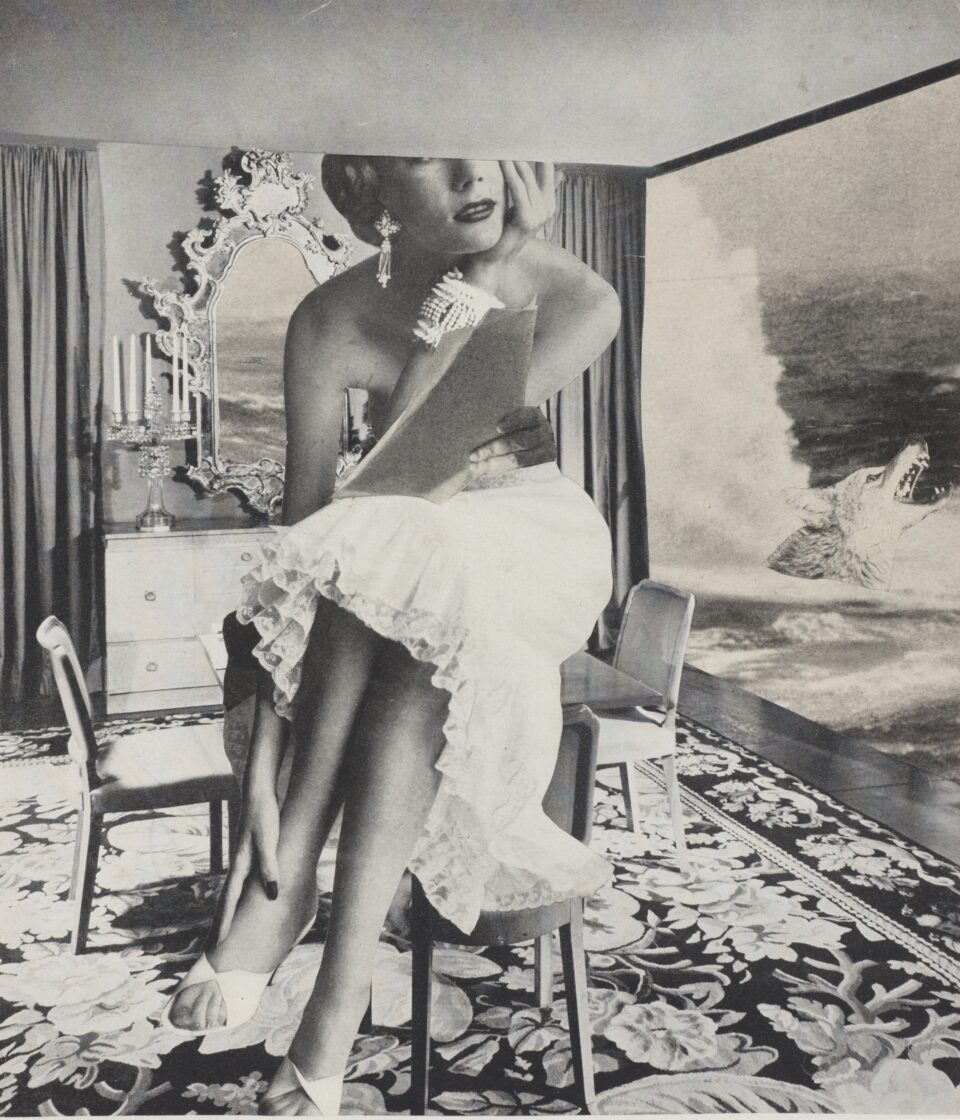
Japan’s surrealist legacy stretches back to the early 20th century, but in the post-WWII decades the style became a particularly potent medium for engaging with the destruction left by war. One of the artists featured at Tate Modern, Toshiko Okanoue (b. 1928), began making otherworldy photo-collages in Tokyo during the early 1950s, using images cut from imported magazines. She was initially unaware that artists such as Max Ernst had pursued similar techniques to probe the recesses of the mind, though she came to draw such connections via Shūzō Takiguchi (1903-1979), a galvanising force within Japanese Surrealism. Scenes of catastrophe – decimated cityscapes, raging seas – abound in Okonoue’s cut-out world, often foregrounding female figures, many of them with limbs and heads removed or replaced.
Surrealism’s early polemicists associated femininity with unconscious or “automatic” creation, and masculinity with order, reason and civilization. But for artists such as Carrington, Okanoue, and the French photographer Claude Cahun (1894-1954), the style became a vehicle for resisting gender stereotypes. Cahun is known for assuming multiple theatrical personae in portrait shots, some of the most famous of which feature her characteristic cropped hair and “monk-like” appearance. In a 1930 memoir entitled Disavowals, the artist wrote that: “neuter is the only gender that always suits me.” Many contemporary trans and non-binary writers and artists – including journalist Juliet Jacques, who discusses Cahun’s work on the Bow Down women’s art podcast – have Cahun’s principles as a point of inspiration for their own journeys through gender and creativity.
Surrealism Beyond Borders runs at Tate Modern until 29 August. Find out more here.
Words: Greg Thomas
Image Credits:
1. Toshiko Okanoue The Call 1953. Wilson Centre for Photography © Okanoue Toshiko, Courtesy of The Third Gallery Aya
2. Claude Cahun Self-portrait (kneeling, naked, with mask) 1928. Courtesy of Jersey Heritage Collections © The estate of Claude Cahun
The post Global Influence appeared first on Aesthetica Magazine.
from Art Life Culture https://ift.tt/PHJO8uz
via IFTTT



No comments:
Post a Comment